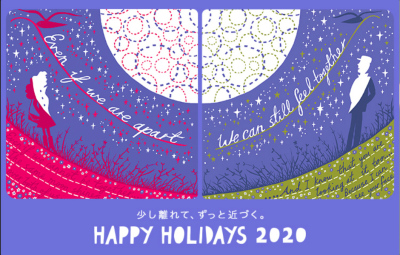
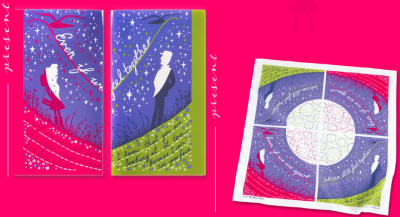
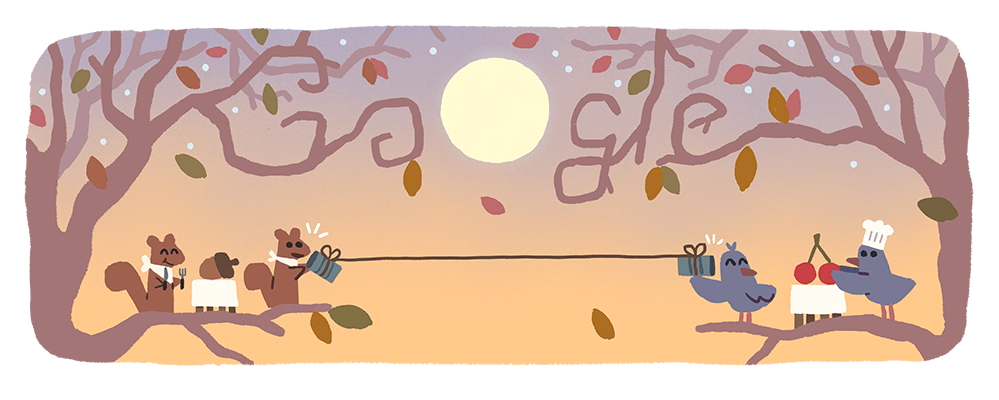
2020年12月1日「ホリデーシーズン」のGoogle

12月のいろいろ
針供養・御事始め・御事納め 【12月8日】 その字のとおり「針を供養」する行事。
そろそろお歳暮を贈る時期。
正月事始め 【12月13日】 ・煤払い
冬至(とうじ)【12月22日】
クリスマス 【12月25日】
大晦日・年越し 【12月31日】

https://g.co/doodle/zxjq4ny
https://www.google.com/doodles?hl=ja
google "bird"


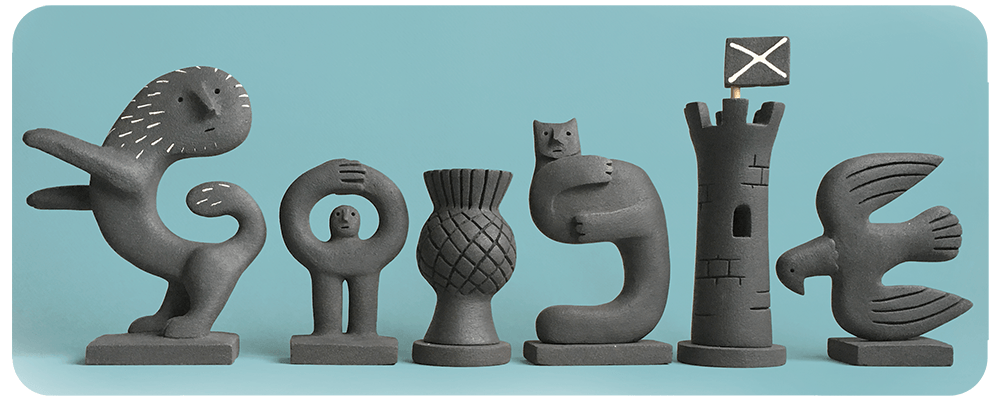
Today’s Doodle, illustrated by guest artist Peter Lubach, commemorates St. Andrew’s Day, Scotland’s annual celebration of its patron saint and national culture. The traditions of St. Andrew’s Day are believed to trace all the way back to the 11th century, and in 2007 the celebration was officially established as a national holiday.
In honor of St. Andrew’s Day, today’s Doodle artwork features several emblematic elements of Scottish iconography. The rampant lion on the far left has long represented Scotland since its first appearance on official regalia in the 13th century. Scotland’s national emblem, the thistle, replaces the second “O,” and to its right sits the critically-endangered Scottish wildcat—the only remaining native cat species that lives in the wild in the UK. Next to the wildcat stands a castle representative of the historic structures that dot the Scottish landscape. And finally on the far right is a golden eagle, which symbolizes Scotland’s wild natural landscape.
Happy St. Andrew’s Day!


Today’s Doodle, illustrated by Spain-based guest artist Cinta Arribas, celebrates Spanish clown, actor, director, writer, singer, and composer Emilio Aragón Bermúdez, known fondly by his stage name Miliki. Among his many artistic accomplishments, Aragón starred in the Spanish children’s program show “El Gran Circo de TVE” (“TVE’s Great Circus”) which is widely considered one of most iconic shows in the history of Spanish television.
Emilio Alberto Aragón Bermúdez was born on this day in 1929 in the town of Carmona in southwestern Spain. The son of a clown and an equestrian acrobatics specialist, Aragón honed his talent for performance art as a child surrounded by entertainers. Determined to carry on the family tradition, Aragón launched his clowning career by the age of 11, performing with his brothers at venues like Madrid’s legendary Circo Price (Price Circus).
The siblings moved to Cuba in the 1940s and achieved fame over the following decades as they showcased their endearing talents across the Americas. They found their way back to Spain in 1972 and the very next year, they took Spanish television by storm as the hosts of the children’s show which eventually became known as “El Gran Circo de TVE.”
After a hugely successful decade on air, Aragón moved beyond his identity as a clown and throughout the rest of career explored new endeavors as a writer, TV presenter, filmmaker, and recording musician—a talent which earned him two Latin Grammy Awards.
¡Feliz cumpleaños, Miliki!

Today’s Doodle celebrates Nigeria’s Independence Day, which is observing its 60th anniversary this year! On this day in 1960, Africa’s most populous nation declared its independence from British colonial rule. The momentous occasion signified the sovereignty and unity of Nigeria’s 36 states and was marked with fireworks, dancing, and a state banquet. Over the years, Independence Day has been an opportunity for Nigerians to showcase their rich and varied culture, from suya (spicy meat skewer) and jollof rice (one-pot tomato rice) to juju music and afrobeats.
The artwork in today’s Doodle is a nod to Nigeria’s coat of arms— specifically the eagle which represents strength. The primary colors of the Doodle are the same as Nigeria’s national colors: green signifying the country’s agricultural wealth and white a marker for unity and peace.
Happy Independence Day, Nigeria!

Today’s Doodle, illustrated by Xalapa, Mexico-based guest artist Ina Hristova, celebrates Mexico’s Independence Day. On this day in 1810, Mexico’s decade-long struggle for independence from Spanish rule began, and the country’s sovereignty was officially recognized by Spain on August 24, 1821.
Depicted in today’s Doodle is a colorful and eclectic collection of images that represent traditional Independence Day festivities. These illustrations pay homage to an iconic Mexican folk embroidery style developed in the 1960s by the Indigenous Otomí people of Tenango de Doria in central Mexico. The shape of the Doodle artwork is inspired by the central Mexican folk sculptures called “Árboles de la Vida” (“Trees of Life”).
iFeliz Día de la Independencia, México!

Mascha Kaléko:マーシャ・カレコ(1907年6月7日〜1975年1月21日)
女性詩人。
現在のポーランドでユダヤ系の家系に生まれる。
第一次世界大戦が始まりドイツへ移住。1928年結婚。
1933年詩集「Das lyrische Stenogrammheft. Verse vom Alltag.」発表。
2年後に「Kleines Lesebuch für Große. Gereimtes und Ungereimtes.」を発表。
作風は、風刺的で口語調でスタイリッシュ。曲がつけられた詩もある。
ナチスによるユダヤ人への迫害がはじまり、彼女の詩集も禁止される。
離婚後、音楽家の男性と再婚。1938年アメリカへ移住。
1950年代半ばにドイツに戻り、その後、夫の仕事の都合でイスラエルに移住。
「1974年9月16日」は彼女がニューヨークのアメリカ記念図書館で詩の朗読会と公演を行なった記念日。
Today’s Doodle, illustrated by Hamburg-based guest artist Ramona Ring, celebrates the German-Jewish poet Mascha Kaléko, whose incisive poems and chansons earned her notable acclaim among the literary avant-garde in 1930s Berlin. On this day in 1974, Kaléko held her final reading in Berlin’s America Memorial Library.
Mascha Kaléko was born Golda Malka Aufen in 1907 in Schidlow, Galicia, in what is today southern Poland. With the outbreak of World War I, she and her family fled the country for Germany and eventually made a new home in Berlin in 1918.


Today’s Doodle, illustrated by guest artist Yuko Shimizu, celebrates the 116th birthday of Japanese novelist, essayist, and feminist Aya Kōda, widely revered as one of the most luminary Japanese authors of her time. Kōda’s writing eloquently explored topics like familial relationships, gender roles, and traditional Japanese culture, and she came to be closely associated with the appearance of the kimono in her work.
Aya Kōda was born on this day in 1904 in the Japanese capital of Tokyo. Her father, Rohan Kōda, was one of Japan’s most esteemed authors, and Kōda began her writing career at age 43 with an essay about him for a literary journal.
In the 1940s and ‘50s, Kōda honed her captivating style through a series of similarly autobiographical essays that chronicled her life with the eccentric Rohan. Despite her unexpected literary success, she stopped writing for several months to work as a maid at a geisha house. Kōda’s experience among the kimono-clad women there inspired her 1955 debut novel “Nagareru” (“Flowing”), which is cited as a critical turning point in her career.
Today’s Doodle artwork depicts Kōda dressed in a kimono, a subject she examined so frequently that her first 1958-’59 essay collection featured covers made of hand-stitched kimono fabric. In the background of the Doodle artwork is the Horinji Temple found in Japan’s Nara prefecture. The Kōda family had strong ties to pagodas, and when a fire caused by lightning burnt down the original Horinji Temple in 1944, Kōda raised money that helped fund its 1970s reconstruction. Kōda went on to produce a prolific body of work, much of which can be found in her 23-volume, career-spanning collection published from 1994-’97.
Happy birthday, Aya Kōda, and thank you for sharing the fabric of Japanese culture with the world!